
Choosing a system
Wet scrubber or activated carbon? Choose by the pollutant
Both systems clean air, but they work on different principles, and choosing the wrong one means paying twice. So the first question is not "which is better?" but "what is our pollutant?"
Two different principles
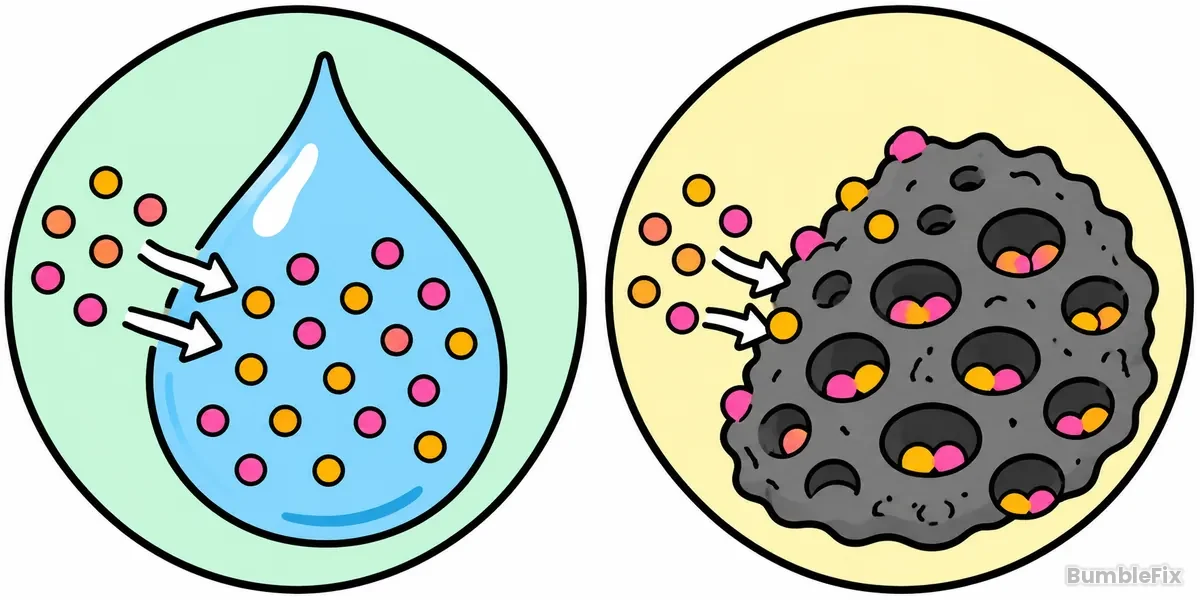
- A wet scrubber uses absorption. The substance goes "into" the liquid by dissolving or reacting chemically, and the droplets can capture dust as well.
- Activated carbon uses adsorption. Gas or vapour molecules stick "onto the surface" of a solid. This is mostly a physical, reversible process, so carbon has a limited capacity and must be replaced when it is full.
Comparison by pollutant
| Pollutant | Wet scrubber | Activated carbon |
|---|---|---|
| General dust | Suitable; choose the type by particle size | Not suitable; dust plugs the carbon bed |
| Dust or fume in hot, humid, sticky or explosive conditions | Suitable | Not suitable |
| Liquid mist | Works for many types | Not a job for carbon; mist plugs the bed |
| Gases that dissolve readily or react with a chemical | Suitable, with a packed tower and the right solution | Assess substance by substance |
| Vapours or gases that do not dissolve in water | Poor capture | Suitable, if the substance adsorbs well on carbon |
| Air carrying both particles and gases | Can be the first stage | Use downstream, after particles are removed |
Mixed contaminants: use devices in series
Most factory exhaust does not contain just one substance. When there are both particles and gases, several devices are often needed in series. The key rule is to remove particles and mist before the carbon bed, because solid particles plug adsorbers and the carbon is used up sooner than it should be.
Other points to compare
| Topic | Wet scrubber | Activated carbon |
|---|---|---|
| Waste to handle | Waste water and sludge | Spent carbon |
| Energy | Fan and water pump | Fan |
| Hot, humid air | Handles it well and cools the air | Condensing water vapour plugs the bed |
| Routine maintenance | Water quality control, bleed, make-up water, demister cleaning | Outlet monitoring and scheduled carbon change-out |
Waste water, sludge and spent carbon should all be treated as potentially hazardous waste until tested.
Information you need before choosing
- Which chemicals are in the exhaust air
- The concentration of each one
- Particle size, if there is dust or mist
- Airflow, temperature and humidity
The first three matter most when choosing a treatment device. "A bad smell" or "smoke" is not enough, because different substances may need entirely different treatment.
When neither is the answer
Some cases call for other technologies, such as thermal or catalytic oxidation for organic vapours, or a biofilter for odours from ammonia and hydrogen sulphide. Here too, the choice has to start from real data on the substances.