
Wet Scrubber
What is a wet scrubber, how does it work, and which pollutants does it suit?
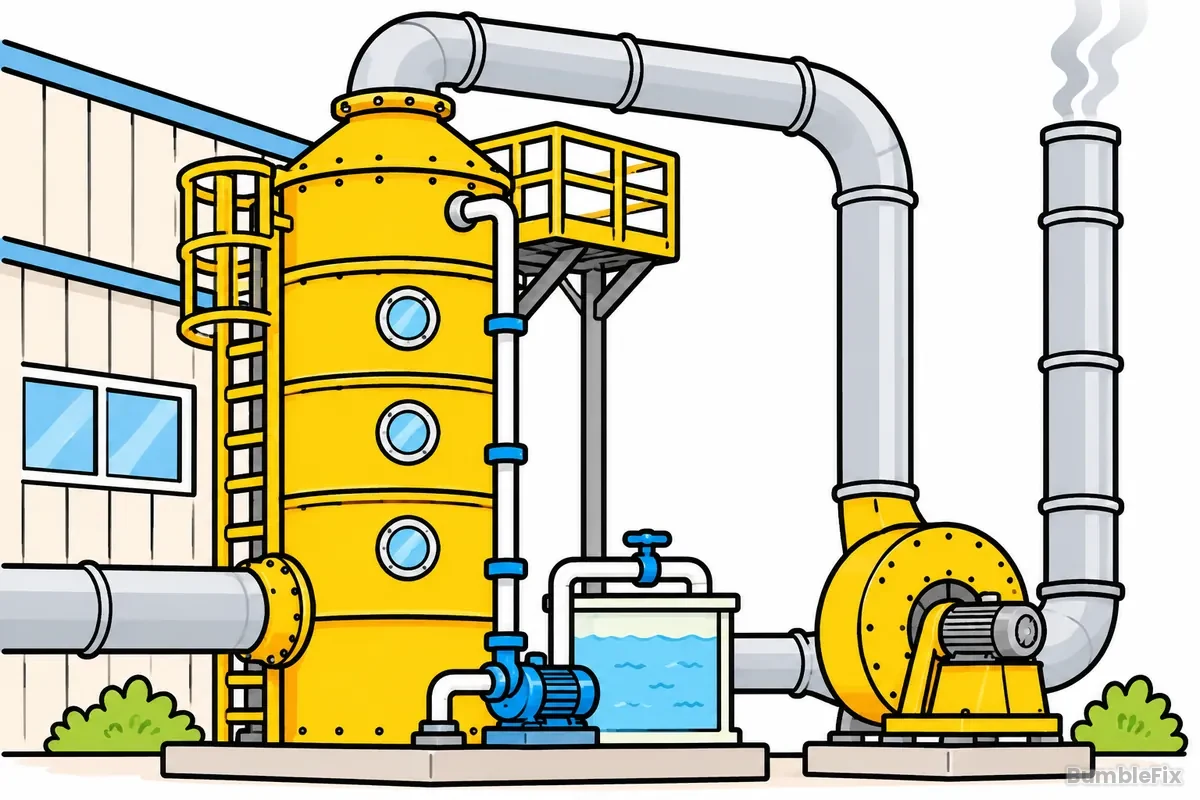
A wet scrubber cleans air by bringing the exhaust into close contact with water or a scrubbing solution. Dust is captured in the droplets, while some gases dissolve or react in the liquid. It is one of the most widely used solutions to air pollution problems in factories.
How it works
Every type works in two stages:
- Contact: mixing air and water as intimately as possible, for example by spraying, passing the air through packing, or accelerating it through a throat.
- Droplet separation: the droplets holding the pollutant must be removed before the air leaves the scrubber, using a demister pad, chevron eliminator or centrifugal separator. If this stage is poor, dirty mist escapes from the stack.
A key principle: for a well-designed scrubber, efficiency depends on the energy used to bring air and water into contact, not on the brand or the design. Scrubbers from different manufacturers that use the same energy give similar efficiency. The smaller the particles you need to capture, the higher the pressure drop you have to accept.
Dust and gases are captured differently
- Dust and mist: particles collide with the droplets and are carried away with them.
- Gases and vapours (absorption): the gas must dissolve in the liquid or react with a chemical in it. Water is the most common absorbent, but additives are often needed. A gas that neither dissolves nor reacts is captured poorly by a wet scrubber.
Common types
| Type | Used for | Gas-side pressure drop (Pa) |
|---|---|---|
| Spray tower | Dust; the lowest efficiency of the wet collectors | 125–375 |
| Packed tower | Gases, vapours and mists; not used for dust, which plugs the packing | 375–875 (per packed bed) |
| Wet centrifugal | General dust; more efficient than a spray tower | 500–1,500 |
| Orifice | Industrial dust | 625–2,750 |
| Venturi | Very fine particles, such as fume | 1,250–25,000 |
Packed towers for gas absorption are usually countercurrent: the gas flows up against liquid flowing down. This gives the highest efficiency because, just before it leaves, the gas meets the cleanest liquid. Typical face velocity into the packed bed is about 1–3 m/s.
Which pollutants it suits
- Gases that dissolve readily in water or react with a scrubbing solution
- Many kinds of liquid mist
- Hot, humid air: wet scrubbers handle high temperatures and moisture that tend to plug dry dust collectors
- Dust that is flammable or explosive when dry: wet collection reduces the hazard, and there is no secondary dust problem when the collected material is disposed of
Points to plan for at the design stage
- Waste water and sludge must be treated before discharge, or the air problem becomes a water pollution problem. Dried sludge should be treated as potentially hazardous waste until tested.
- Corrosion: corrosive substances mixed with water can attack materials severely. The scrubber shell, ducts and pumps must be made of materials that resist the actual chemicals.
- Recirculated water needs a continuous bleed and make-up water. Otherwise solids and neutralisation salts build up and gas absorption efficiency falls.
- Air leaving the scrubber is more humid. The upside is that hot air is cooled and its volume reduced, so a fan after the scrubber needs less power. But this humid air should not be returned to air-conditioned spaces.
How to know a scrubber really works
Efficiency percentages in brochures cannot be compared directly. Wet scrubbers have to be judged by field testing, and the best measure is the actual emission (for example in mg/m³) while the process is running normally.
Also note that capturing 80% of the dust by weight may mean only the coarse particles are being caught, and the stack can still look just as hazy, because fine particles are what make a plume visible.