
Ventilation
Factory ventilation: capture at the source, or dilute the whole room?
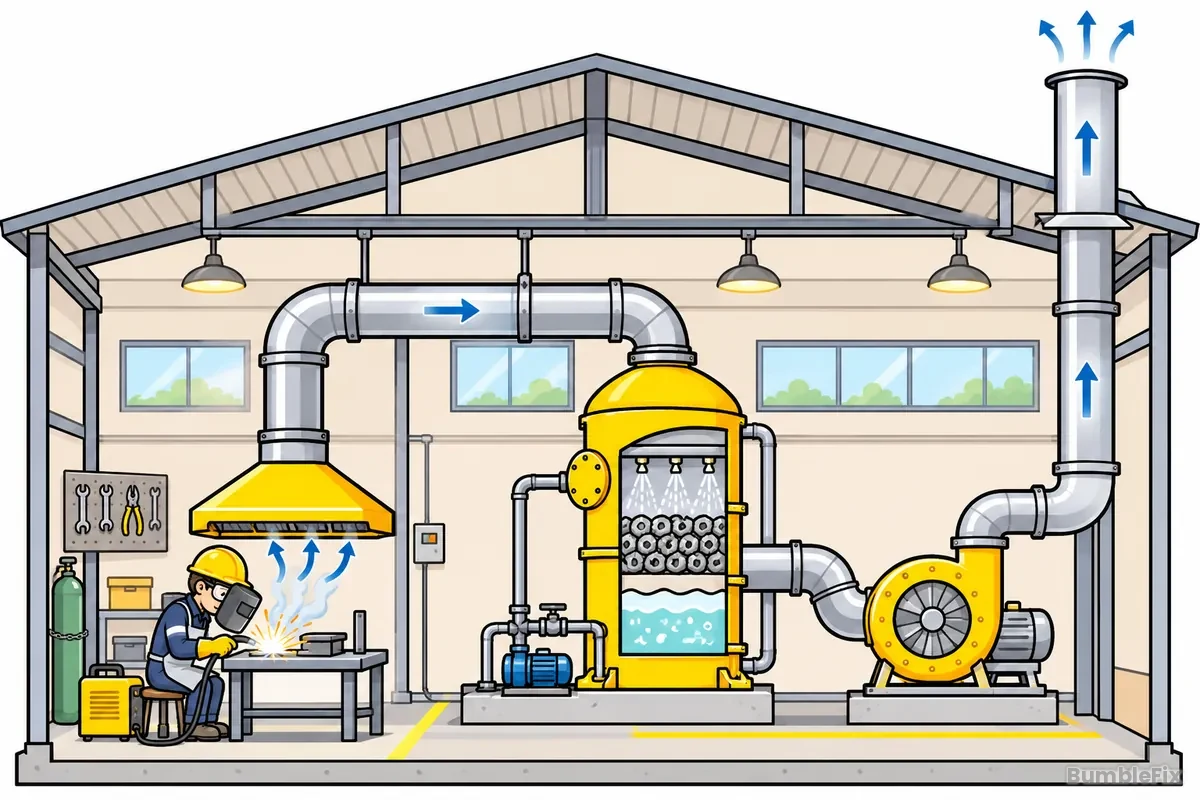
Dust, fumes and chemical vapours in a factory can be handled in two main ways: capture them where they are generated, or bring in clean air to dilute them. Choose the wrong approach at the start and no amount of fan power will fix the problem.
How the two approaches differ
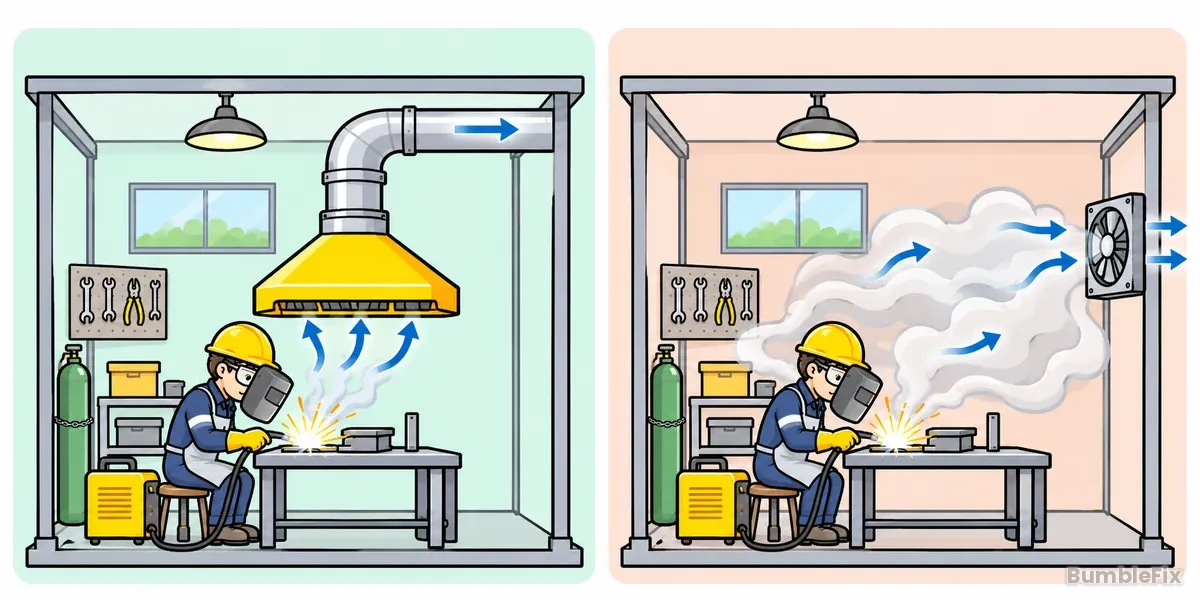
Local exhaust ventilation (LEV) removes contaminants at the point where they are released, before they reach the worker's breathing zone. It works like a kitchen range hood, but is designed for industrial processes.
General (dilution) ventilation lets the contaminant spread into the room first, then uses a large volume of clean air to bring the concentration down, for example with wall or roof exhaust fans.
The five parts of an LEV system
- Hood: the opening that captures the contaminant, and the most important part. If the hood is wrong, nothing downstream can make up for it.
- Duct: carries the contaminated air. Air velocity must be high enough that dust does not settle in the duct.
- Air cleaning device: a dust collector, wet scrubber or activated carbon adsorber, chosen for the properties of the contaminant and the real operating conditions.
- Fan: the heart of the system. It must match the airflow and pressure the system needs.
- Stack: releases the cleaned air to the atmosphere without letting it re-enter the building.
One thing that is often forgotten is make-up air. Every cubic metre of air exhausted must be replaced. Without it, the building goes into negative pressure: doors are hard to open, air leaks in through gaps, and the exhaust system moves less air than it was designed for.
How dilution ventilation works
Dilution follows a mass balance. The room concentration depends on contaminant generation rate ÷ effective airflow, plus whatever concentration the supply air already carries.
Put simply, if contaminant generation doubles, the airflow has to double to keep the same concentration. The word "effective" matters: air in a real room never mixes perfectly, so the airflow that actually dilutes is always less than the figure on the fan's nameplate.
Which one to choose
| Situation | Suitable approach |
|---|---|
| Highly toxic contaminant, or large quantities released | LEV |
| Clearly defined source, such as a welding bench, plating tank or grinder | LEV |
| Workers close to the source | LEV |
| Low-toxicity contaminant, small amounts, released at many points | General dilution ventilation |
| Removing heat or mild odours over a large area | General dilution ventilation |
Common misconceptions
- "Just add more air changes per hour (ACH)." Engineering practice is clear that air changes per hour cannot replace capture at the source when the task calls for LEV.
- "A nice breeze means clean air." Comfort airflow is a comfort criterion, not a capture criterion, and a fan blowing on workers can push fumes away from the hood.
- "Once it is cleaned, the air can go straight back into the building." This is possible in some cases, but only with monitoring and complete data on the contaminant. It is not a shortcut to saving energy.
Summary
Start with three questions: what the contaminant is, where it is released, and how close workers are to it. The answers tell you whether to capture at the source or dilute the room. Good systems often combine both, with enough make-up air.