
Fans
Air pressure and fans: read the numbers before you order a fan

A fan with "plenty of air" in the catalogue may deliver less than half of it once connected to a real system, because the airflow it delivers depends on the resistance of the system it is connected to. Choosing the right fan starts with understanding three pressures.
The three pressures in a duct
- Static pressure (SP): the push or pull on the duct walls. It is negative on the suction side before the fan and positive on the discharge side after it.
- Velocity pressure (VP): the kinetic energy of the moving air. It is always positive.
- Total pressure (TP): TP = SP + VP.
Velocity pressure is calculated from air velocity:
VP = df × (V ÷ 1.29)²
where VP is in Pa, V is air velocity (m/s) and df is the air density factor (df = 1 for standard air). At 15 m/s, VP is about 135 Pa; at 20 m/s it jumps to about 240 Pa.
Why does VP matter? Because almost every loss in the system, including duct friction, elbows, branch entries and hood entry, is calculated as a coefficient × VP.
The square law: a little more air needs a lot more pressure
In an existing system where the ducts and hoods stay the same, the pressure required varies with the square of the airflow:
SSP₂ / SSP₁ = (Q₂ / Q₁)²
| Additional airflow | Pressure required | Fan power (same efficiency) |
|---|---|---|
| +10% | +21% | +33% |
| +20% | +44% | +73% |
| +50% | +125% | +238% |
So "just fit a bigger motor" usually costs more than expected. Better value often comes from reducing losses in the system or moving the hood closer to the source.
FSP and FTP: what the catalogue figures mean
- Fan total pressure (FTP) = outlet total pressure − inlet total pressure
- Fan static pressure (FSP) = outlet SP − inlet SP − inlet VP
Most manufacturers' fan selection tables use FSP. Common mistakes are comparing a single measured SP against the table, or mixing up FSP and FTP, which leads to an undersized fan.
Hot and humid air is lighter than standard air
Most fan tables are based on standard air, but hot air is less dense, so the same fan develops less pressure. The temperature density factor is
df = 294 ÷ (T + 273), with T in °C
Example: at 80°C, df = 294 ÷ 353 = 0.83. If the system needs 1,000 Pa at the actual temperature, read the fan table at an equivalent pressure of 1,000 ÷ 0.83 ≈ 1,200 Pa.
Air carrying a lot of water vapour, such as air leaving a wet scrubber, is also less dense, so a moisture correction has to be included as well.
A quick note: motor speed on 50 Hz power
Synchronous speed = 120 × frequency ÷ number of poles. On Thailand's 50 Hz supply, a 2-pole motor runs at 3,000 rpm and a 4-pole motor at 1,500 rpm. The actual speed under load is slightly lower, so check that it matches the speed used in the fan table.
Checklist before ordering a fan
- Know the actual airflow at the actual temperature and humidity
- Add up every pressure loss: hoods, ducts, air cleaning device and stack
- Convert to FSP or FTP to match the manufacturer's table
- Correct for air density before reading the table
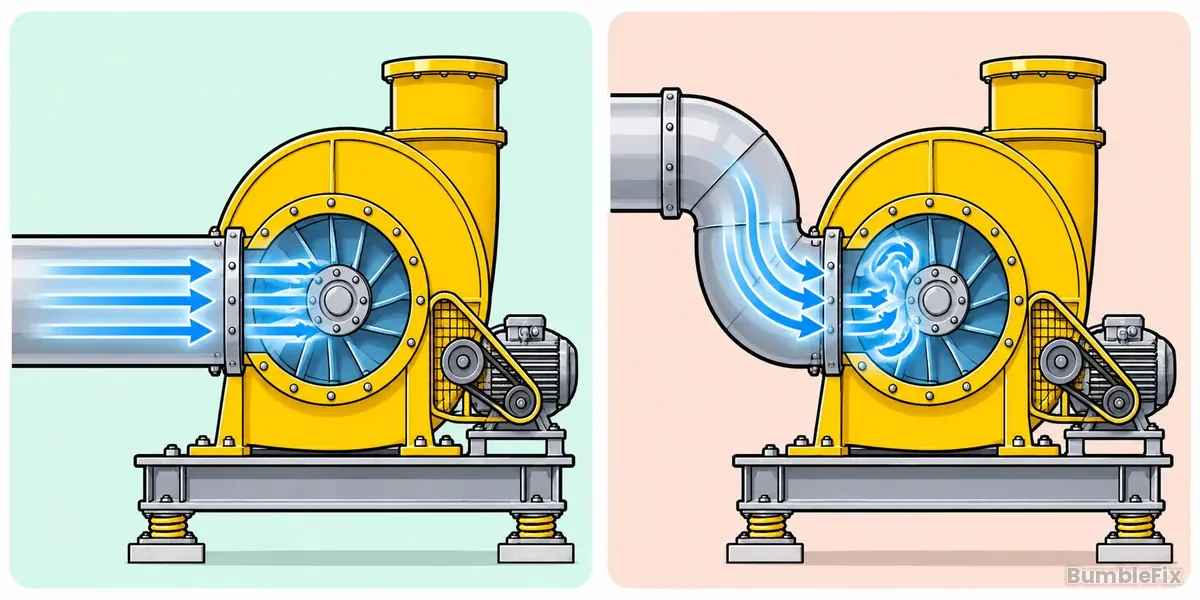
- Provide a straight duct of at least 6 diameters before the fan inlet