
Ductwork
Duct velocity: too slow and dust settles, too fast and power is wasted

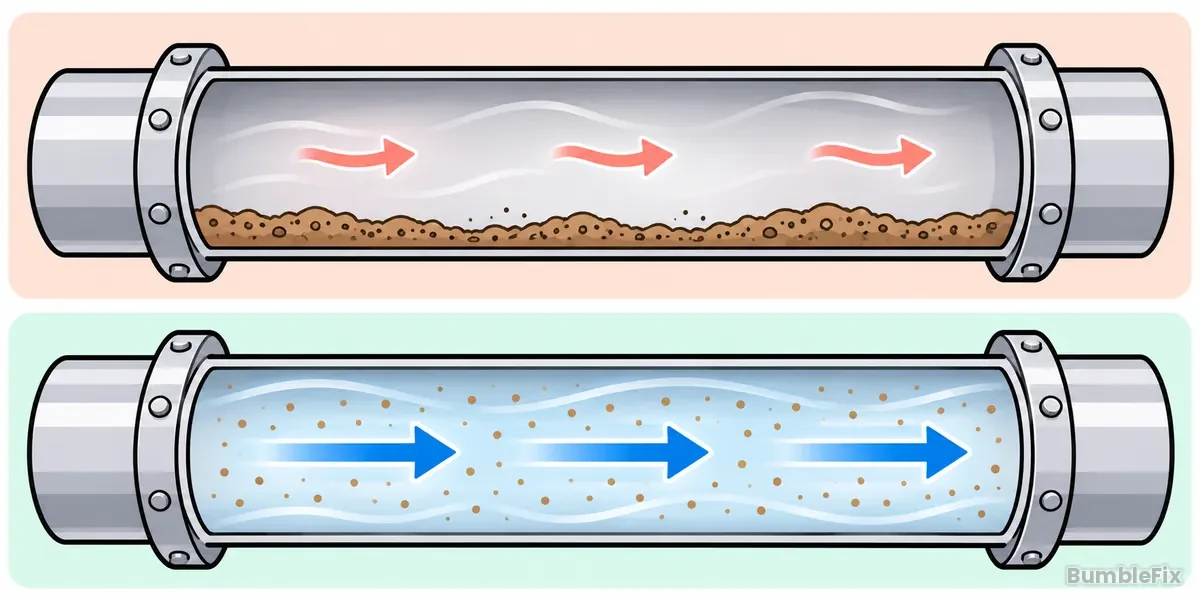
In a dust collection system, the duct is not just a path for air. It is a conveyor that has to deliver all of the dust to the collector. If the air moves too slowly, dust settles on the way. If it moves too fast, power costs and duct wear go up.
Minimum transport velocity
This is the lowest air velocity that still carries particles along without them settling. The heavier or wetter the particles, the higher the velocity needed. Engineering reference ranges are:
| Type of contaminant | Duct velocity (m/s) |
|---|---|
| Vapours, gases, smoke | No minimum; an economical range is usually 5–10 |
| Metal fumes and smoke | 10.2–12.7 |
| Fine, light dust | 12.7–15.2 |
| Dry dusts and powders | 15.2–17.8 |
| Average industrial dust, such as grinding dust, rock dust, material handling | 17.8–20.3 |
| Heavy dust | 20.3–22.9 |
| Heavy or moist dust, such as moist cement dust, lead dust with metal chips | 22.9 and above |
These figures are minimums, not targets, and they must be held in every section of the duct, including the main duct after branches join.
How to size a duct
Start with the target cross-sectional area:
At = Q ÷ Vt
- At = target cross-sectional area (m²)
- Q = actual airflow in that duct section (m³/s)
- Vt = minimum transport velocity (m/s)
Then choose the standard duct size whose area is slightly smaller than At, so the actual velocity does not fall below the minimum.
Example: collecting fine dust at 3,600 m³/h (1 m³/s) with a minimum velocity of 15 m/s.
- At = 1 ÷ 15 = 0.0667 m², equivalent to a round duct of about 291 mm diameter.
- Choose a 280 mm duct (area 0.0616 m²). Actual velocity = 1 ÷ 0.0616 = 16.2 m/s. This meets the minimum.
- A 300 mm duct "for spare capacity" (area 0.0707 m²) gives only 14.1 m/s, below the minimum, so dust is likely to settle.
This is why "go bigger to allow for the future" is usually the wrong approach for dust collection.
Why too fast is also a problem
Pressure losses in straight duct, elbows and branch entries are calculated as multiples of the velocity pressure, which varies with the square of velocity. As velocity rises, the pressure the fan has to develop rises much faster, bringing higher power costs, more noise and faster wear when the dust is abrasive. A good design velocity sits only slightly above the minimum.
Choosing duct shape and material
- Round duct is the first choice for most exhaust, air pollution control and dust collection systems.
- Rectangular duct only where space is too tight, and kept as close to square as possible.
- Galvanised steel duct is not recommended above 204°C.
- Corrosive contaminants, such as acid vapours, require a compatibility check between the chemical and the duct material, since plastics differ in their chemical and heat resistance.
Warning signs that duct velocity is too low
- Tapping a horizontal duct gives a dull sound, or the duct starts to sag under the weight of dust.
- Airflow at the hoods falls a little every month even though the fan runs normally.
- The system has to be stopped to open and clean the ducts more often than it should.