
Hoods
Capture hoods: double the distance and you need almost four times the airflow
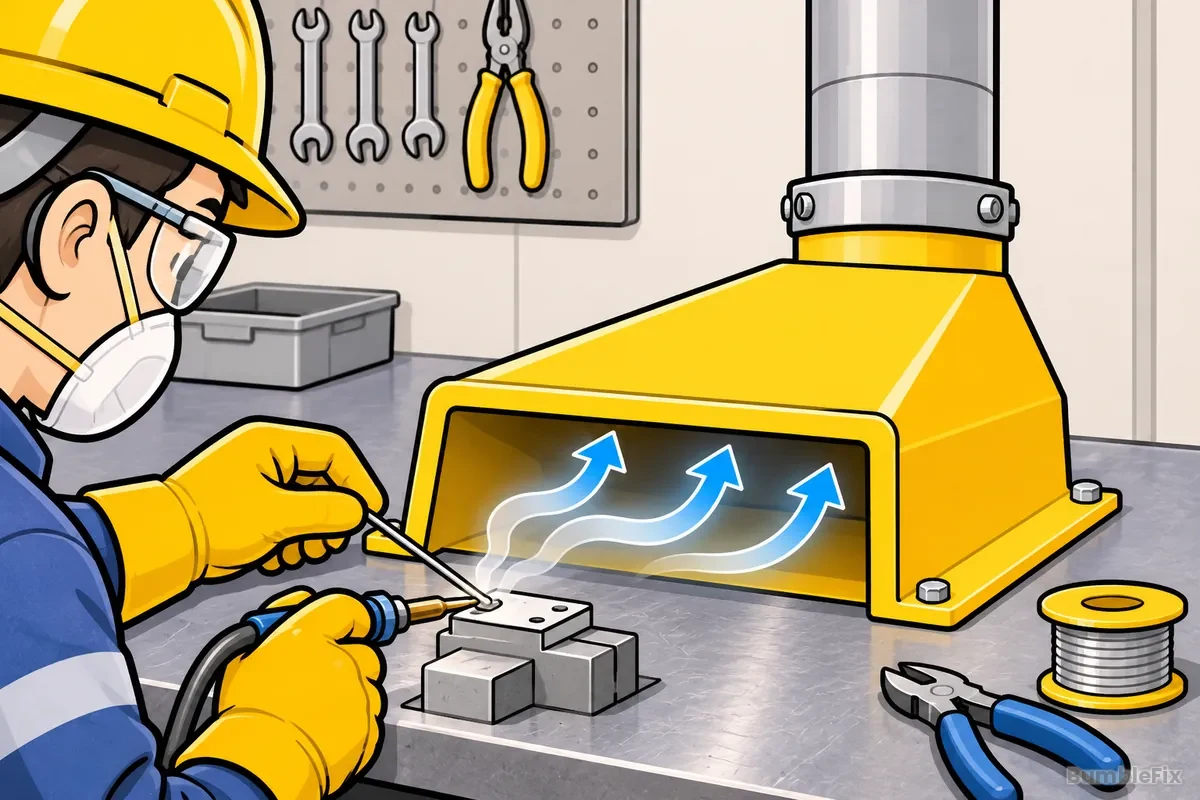
The hood is the first line of defence in an exhaust system. If it fails to capture the fumes, it does not matter how strong the fan or how good the scrubber is: the contaminant has already escaped into the air people breathe.
Three common hood types
- Enclosing hood: surrounds the source almost completely, such as a fume cupboard or paint booth. It needs the least air and gives the best control.
- Capturing hood: sits beside the source and has to create an air current that pulls the contaminant in, such as a hood beside a welding bench or a slot hood along a plating tank.
- Receiving (canopy) hood: catches hot fumes that rise on their own, such as a canopy over a hot tank. It works well when the fumes really are hot, but if workers lean over the tank, their heads sit right in the fume path.
A simple rule: the more you enclose, the less air and electricity you need.
What capture velocity means
Capture velocity is the air velocity needed at the point where the contaminant is released to overcome cross-drafts and draw it into the hood. It is not the velocity at the hood face. The right value depends on how forcefully the contaminant is released and how much the surrounding air moves, so it has to be assessed on site.
For a free-standing capturing hood with nothing around it, the airflow required is
Q = Vx × (10X² + Af)
- Q = exhaust airflow (m³/s)
- Vx = required capture velocity at the point of release (m/s)
- X = distance from the hood face to the point of release (m)
- Af = hood face area (m²)
Distance is the most expensive variable
Because X is squared, a small increase in distance makes the airflow climb steeply. Take a hood with a face area of 0.05 m² at the same capture velocity:
| Distance from hood face (cm) | Airflow needed (relative to 30 cm) |
|---|---|
| 15 | 0.29× |
| 30 | 1× |
| 60 | 3.84× |
Moving the hood from 30 to 60 cm means the fan, ducts and scrubber all have to handle almost four times the airflow. Before buying a bigger fan, ask whether the hood can be moved closer.
Two ways to cut airflow at almost no cost
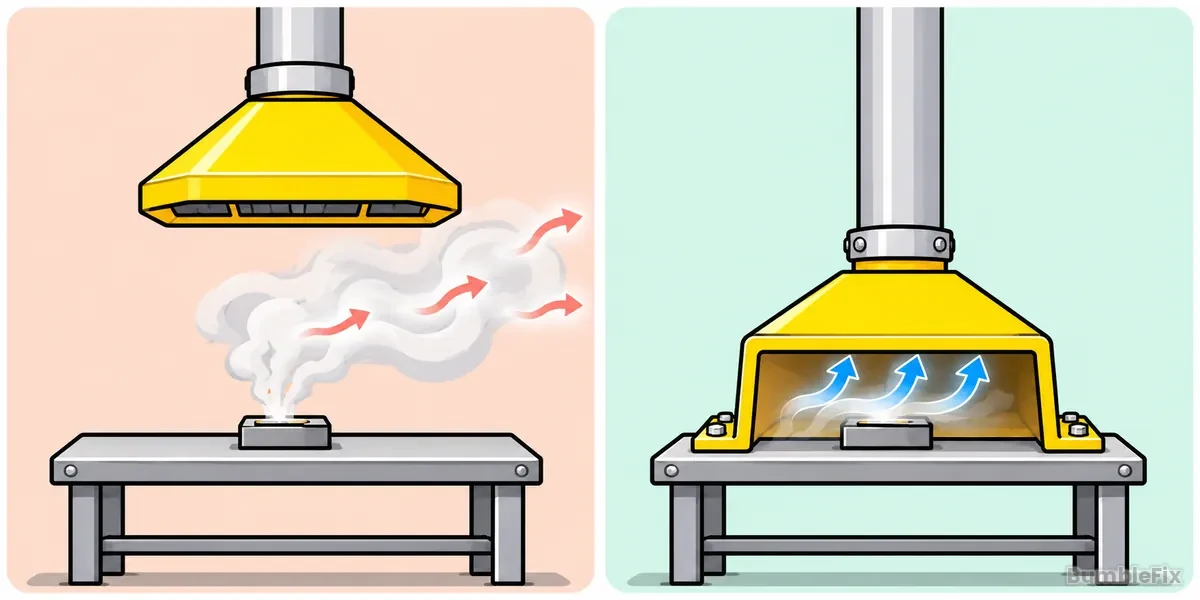
- Add a flange around the hood opening. The flange stops the hood from drawing air from behind, where there is no contaminant. The formula becomes Q = 0.75 × Vx × (10X² + Af), a saving of about 25%.
- Place the hood on the bench or work surface. The surface acts like a wall on one side. The formula becomes Q = Vx × (5X² + Af).
Doing both gives Q = 0.75 × Vx × (5X² + Af). In the example above at 30 cm, the airflow needed drops to about 40% of a free-standing hood without a flange.
How to check that a hood is still working
Every hood loses some pressure at its entry, so the static pressure measured in the duct just after the hood (hood static pressure) tells you how healthy the hood is. For a given hood, airflow varies with the square root of this value.
In practice, record the value when the system is new as a baseline, then measure it again at regular intervals. If it keeps falling, the airflow at the hood is falling too. Likely causes are a blocked duct, a leaking duct, a slack fan belt or a clogged filter.
Common mistakes on site
- Mounting the hood far from the source so it does not get in the way.
- A pedestal fan blowing across the hood face, pushing fumes out to the side.
- Assuming a bigger hood is better, when a bigger face area also needs more air.
- Exhausting against the direction the contaminant moves, such as a floor-level hood for hot fumes that rise.