
Activated Carbon
How activated carbon adsorbs vapours, and when to replace it
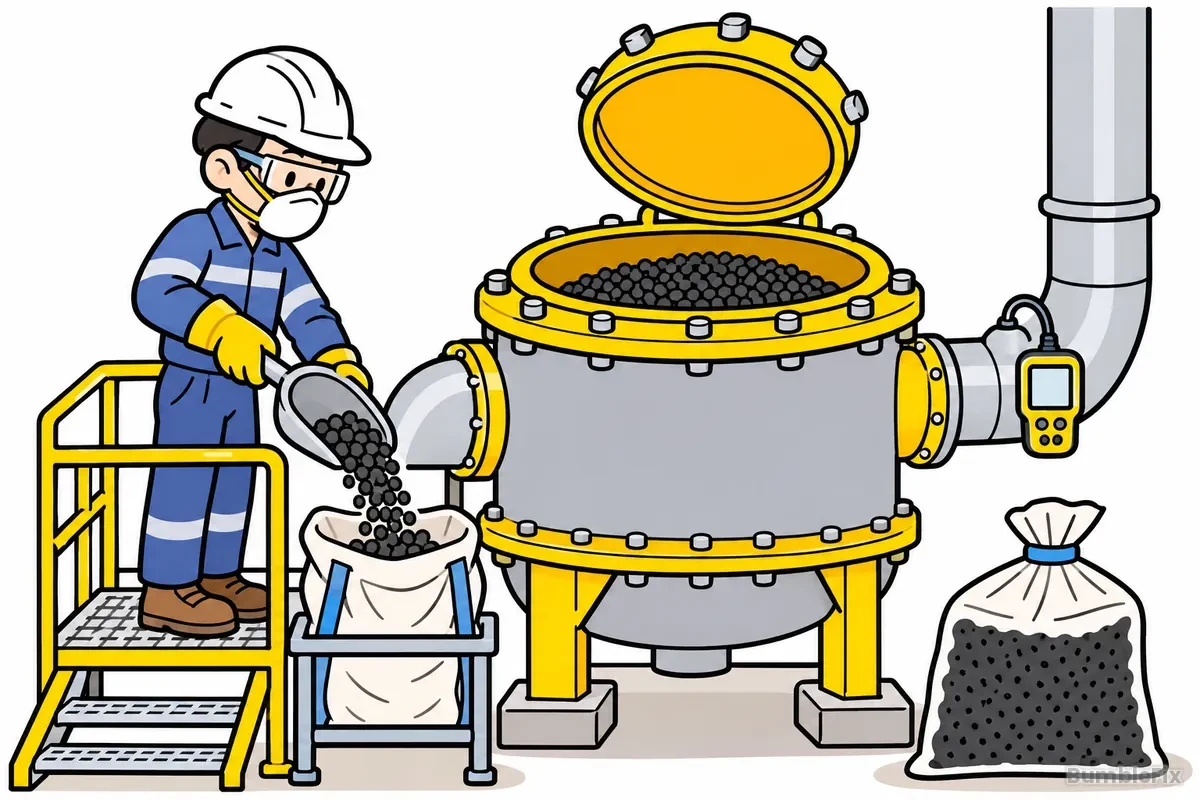
An activated carbon adsorber looks like simple equipment: no water, no pumps. But it has one important weakness: the carbon can become saturated without any warning. The fan keeps turning and the air keeps flowing, while vapours may have been escaping from the stack for a long time.
What adsorption is
Adsorption is when gas or vapour molecules stick to the surface of a solid. As air passes through the carbon bed, those molecules are left behind on the carbon surface. They are held in one of two ways:
- Intermolecular (van der Waals) forces: a relatively weak, reversible physical bond.
- Chemisorption: a stronger, chemical bond.
Activated carbon is the most popular adsorbent. Others include activated alumina, silica gel and molecular sieves. This is different from absorption in a wet scrubber, where the substance has to dissolve into a liquid.
Saturation and breakthrough
The carbon surface can only hold so many molecules. Over time the bed fills layer by layer from the inlet side, until vapour starts to pass through to the outlet. This is called breakthrough. From this point on, the adsorber provides little or no treatment.
The problem is that you cannot see this point, and the pressure drop across the bed does not show it either. A rising pressure drop usually means dust or mist is plugging the bed, not that the carbon is saturated.
When to replace the carbon
The short answer: replace it based on data, not guesswork. Engineering practice advises against installing an air cleaner without reliable data on breakthrough and change-out timing, and without a way to detect when breakthrough has occurred. In practice that means:
- Measure the outlet concentration regularly while the process is running normally. This is the most reliable indicator.
- Record every result. Outlet levels change over time and with production, so collect data covering every operating period, then set a change-out interval that leaves a margin before breakthrough.
- Have a way to detect breakthrough, such as an outlet monitor with an alarm, especially if treated air is returned to the building.
- Watch for warning signs on site. Returning odours or rising stack test results mean the change-out point has already passed, so they should not be used to set the main schedule.
Carbon life depends on the substance, its concentration, the airflow and the amount of carbon in the bed, so there is no ready-made change-out interval that suits every plant. Estimating carbon life requires the carbon supplier's data together with real measurements.
Getting the most from your carbon
- Remove dust and mist before the bed. Solid particles plug the carbon bed, reduce airflow and cover the carbon surface before it can be used.
- Prevent water vapour from condensing in the bed. Condensed water causes the media to cake and clog. Take particular care when the air comes from a humid process.
- Design for easy change-out, with charging and discharge ports and working space around the vessel. If change-out is difficult, it tends to be postponed again and again.
Handling spent carbon
Spent carbon is loaded with the substances it has captured. Treat it as potentially hazardous waste until tested, and manage it in line with industrial waste regulations. It should not be thrown away with general waste.